





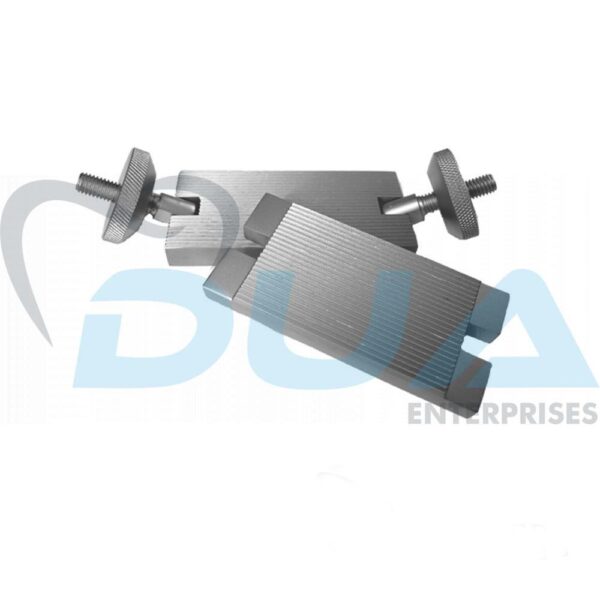

KISTLER ANTHELIX CARTILAGE RASP

Rojdmark rhinoplasty instrument
Introduction:
A combined cartilage holder and crusher is described that allows the surgeon to hold, crush, morselize, and suture a single piece or stack of cartilage graft without letting it slip. The customized slit-shaped jaws allow adequate room for the suture needle, while the serrated surfaces hold the cartilage firmly. The use of this instrument is advocated primarily in rhinoplasty for manipulating and suturing a small cartilage graft or a stack of grafts. The use of this instrument may be extended to aesthetic or reconstructive cases where cartilage grafts need to be sutured or shaped, as in eyelid, ear, and nipple reconstruction
Instruments Detail:
The instrument is similar in size (200 mm× 95 mm) to a bone nibbler. It has two elongated flattened jaws whose serrated sur-faces precisely meet each other (Figs. 1-3). Each jaw (28 mm× 16 mm) has a 2 mm× 15 mm longitudinal slit in its middle that extends nearly two-thirds of the length of the jaw (Figs. 1-3). The jaws taper towards their distal end. The instrument is de-signed with a double-action hinge to allow for strong pressure to be applied and is similar in height and weight to a bone nibbler, familiar to most surgeons. The serrated flattened jaws provide a firm hold on either side to allow the graft to be cut to the desired shape and size. In order to suture, the graft is held so that the point to be sutured is positioned in the slit. The slit is wide enough to allow the curve of a suture needle to pass through with ease. It is also long enough to accommodate varying lengths of cartilage graft. If needed, the flattened jaws can also be used to crush the graft as well.
Why we need to make Instruments:
Cartilage grafts are commonly sourced from nasal septal, con-chal, or rib cartilage. Due to its unique cellular structure, low metabolism, and nutrition by diffusion , cartilage can be stacked in layers. A cartilage graft may be used as a strut, as a layered graft, or as a filler in primary or secondary rhinoplasty. The graft may additionally be morselized and/or crushed to achieve the desired configuration. Importantly, an increase in graft thickness can only be achieved by stacking layers of thin cartilage, or by carving a block of rib cartilage. The current method of handling cartilage grafts is with forceps to perform layer-by-layer suturing. Morselizers are used to make these grafts more supple in order to enhance the nasal form without creating visible deformities.In many instances, however, handling multiple cartilage pieces with forceps and simple morselizers in a layer-by-layer manner can be very difficult. The cartilage pieces tend to slip, and the suture holding the morselized pieces does so in an imprecise manner. Suturing together pieces of cartilage becomes increas-ingly difficult with smaller and thinner graft material and when multiple layers of cartilage are involved. The use of toothed for-ceps tends to break the graft, and even Adson Brown cartilage forceps do not always allow delicate manipulation. Passing a fine suture (5/0 or 6/0 monofilament) through the cartilage can therefore be difficult and frustrating for the surgeon. In the pres-ence of thin pieces of graft, there is a risk of imprecise suture placement or breakage of the graft while manipulating it. Ideally, the cartilage needs to be held in two places with precision and an appropriate amount to force to hold it steady for manipula-tion and suture placement. The senior author ( JR) has an annu-al practice of over 300 rhinoplasties and frequently encounters these problems. The instrument presented in this paper was therefore designed to address the perceived shortcomings of ex-isting instruments in manipulating and working on cartilage grafts.The senior author has been using this instrument for many months now, and it has replaced a traditional (often smaller and less controllable) morselizer and forceps for handling cartilage grafts. We believe this would be a very welcome instrument in the hands of any rhinoplasty surgeon for handling graft material for simple primary rhinoplasties, as well as complicated second-ary cases. Since the instrument can work with any cartilage graft, its use may not be limited to rhinoplasty. Cartilage grafts are used in reconstructive surgery (e.g., eyelid and auricular recon-struction) as well as aesthetic surgery (e.g., nipple reconstruc-tion). The instrument described herein may therefore be used for cartilage manipulation in those situations as well. The use of high quality instruments is fundamental for con-trolled manipulation of tissues, minimizing surgical trauma, de-creasing the duration of the operative procedure and, ultimately, ensuring consistent postoperative results. The instrument de-scribed and developed herein has helped make rhinoplasty pro-cedures easier in our practice. This new instrument makes it Röjdmark J et al. Combined cartilage graft crusher and holder possible to accurately suture the pieces of cartilage together by holding them firmly to prevent any slippage of the individual cartilage pieces, thereby saving time and avoiding unnecessary frustration. It also doubles as an instrument for morselizing car-tilage, avoiding the need for a separate instrument for that pur-pose.

